When Bingo Meets Craps: Uncovering Shared Mathematical Foundations in Random Number Generation
Written by Tina Roth · Jul 24, 2026

When Bingo Meets Craps: Uncovering Shared Mathematical Foundations in Random Number Generation
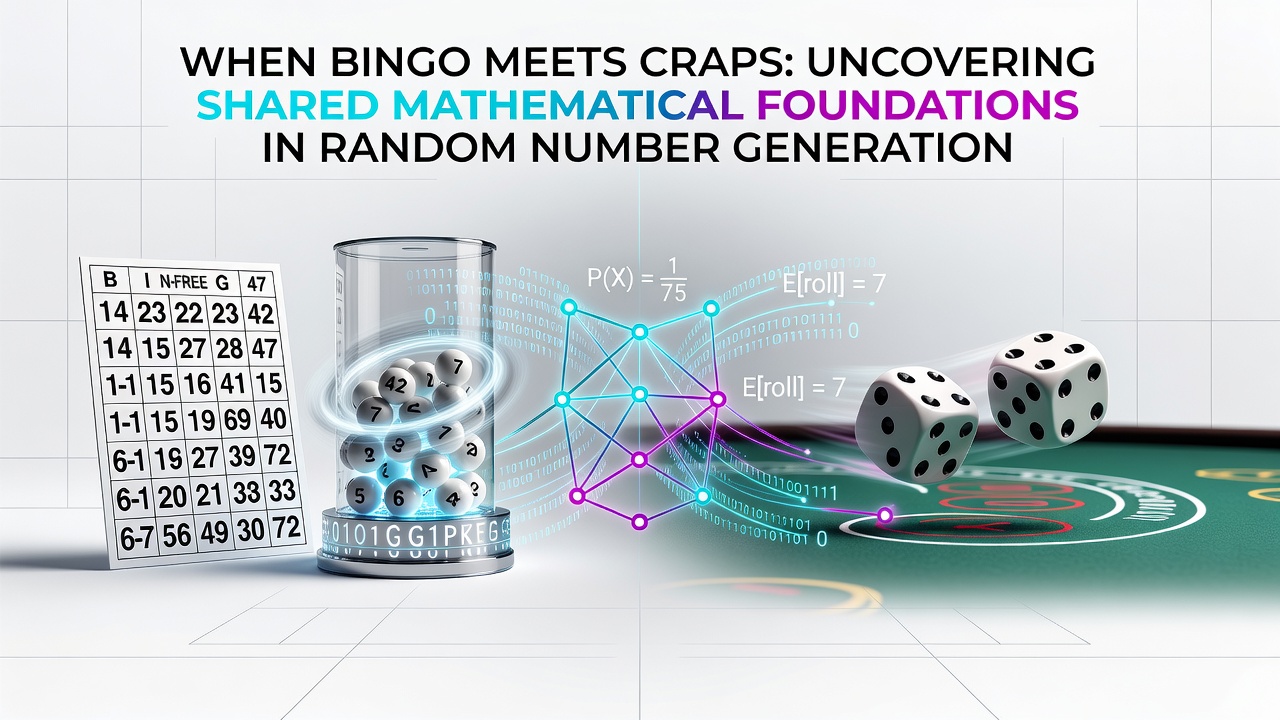
Both bingo and craps depend on random outcomes that follow identical statistical principles, yet the games appear quite different on the surface. Bingo relies on numbered balls drawn from a cage or electronic selector while craps uses pairs of dice tossed across a felt table, and each system produces sequences that observers can analyze through the same probability frameworks and distribution models. Researchers have examined how these games share core requirements for uniformity, independence, and unpredictability in every result.
Core Randomness Requirements in Both Games
Bingo sessions call for each number between 1 and 75 to appear with equal frequency across long series of draws, and craps demands that each face of a six-sided die lands exactly one-sixth of the time when tested over thousands of rolls. Studies from gaming laboratories show that both games must satisfy the same tests for statistical randomness before regulators approve equipment or software. Engineers apply chi-square tests and serial correlation checks to bingo ball machines and craps dice sets alike, confirming that past results do not influence future ones.
Physical equipment in land-based venues undergoes regular calibration, whereas online platforms replace mechanical components with algorithms that generate numbers through deterministic processes seeded by external entropy sources. Data from multiple jurisdictions indicate that certified random number generators must pass the same battery of statistical suites whether the end application is a bingo card fill or a craps dice simulation.
Uniform Distribution and Event Independence
Uniform distribution forms the mathematical backbone that links the two games directly. In bingo every number holds an identical 1-in-75 chance on each draw until teh pool resets, while in craps each die face maintains a 1-in-6 probability on every throw. Observers note that this equality allows analysts to calculate expected frequencies and compare them against actual outcomes using identical formulas. Event independence further connects the games because neither a bingo draw nor a craps roll carries memory of previous results.
Probability calculations for pattern completion in bingo mirror the combinatorial counting used to determine point or come bet success in craps. One study revealed that the same binomial distribution models predict both the likelihood of covering a specific bingo pattern within a fixed number of calls and the chance of rolling a particular total on two dice within a set number of throws. Those who've studied these systems recognize that the underlying equations remain interchangeable even though the surface rules differ.
Transition to Digital Implementations
Online versions of both games rely on pseudorandom number generators that must replicate the statistical behavior of their physical counterparts. Software developers seed these algorithms with inputs from hardware noise sources, atmospheric data, or cryptographic functions to prevent predictability. Regulatory bodies in Nevada and several Canadian provinces require independent testing of the same generator code when it powers either bingo or craps products.
Figures released by testing laboratories reveal that pass rates for DIEHARD and NIST statistical test suites stay consistent across bingo and craps RNG submissions. Engineers adjust return-to-player percentages through game mathematics rather than by altering the underlying random source, preserving teh integrity of distribution properties in both titles. In July 2026 the International Association of Gaming Regulators plans to publish harmonized technical standards that explicitly reference shared RNG evaluation criteria for these and similar chance-based games.
Entropy Sources and Certification Processes
Physical bingo draws extract entropy from mechanical mixing, while craps dice obtain it from the chaotic motion of thrown cubes. Digital systems harvest entropy from ring oscillators, thermal noise, or timing variations in computer hardware. Certification agencies apply identical evaluation protocols to verify that each source supplies sufficient unpredictability before approving deployment. Reports from Australian testing facilities and European gaming labs demonstrate that the same entropy quality thresholds apply regardless of the game type.
Operators maintain audit trails that log every generated number for both bingo and craps, allowing regulators to rerun statistical analyses on historical data. These records confirm continued adherence to uniform distribution and independence requirements over time. Academic papers on applied probability frequently cite examples from both games when illustrating how large-sample behavior converges on theoretical expectations.
Practical Implications for Game Design
Game designers calculate house edges and payout structures using the same random number properties for bingo pattern probabilities and craps wager outcomes. Combinatorial mathematics determines the frequency of specific results, and simulation software models millions of trials to validate theoretical predictions before release. Because the foundational randomness models overlap, teams working on one title can transfer testing methodologies directly to the other without modification.
Regulatory submissions often include side-by-side comparisons of RNG performance metrics for bingo and craps modules running on identical generator platforms. Such documentation streamlines approval processes while maintaining consistent standards across product lines. Observers note that this reuse of mathematical foundations reduces development costs and accelerates time-to-market for new variations of either game.
Conclusion
Bingo and craps converge on identical mathematical requirements for random number generation despite their distinct gameplay surfaces. Uniform distribution, event independence, and rigorous statistical validation apply equally to mechanical ball draws, physical dice rolls, and their digital counterparts. Certification frameworks and entropy evaluation methods remain consistent across both games, while upcoming standards updates scheduled for July 2026 will reinforce these shared technical expectations. Research institutions and regulatory laboratories continue to publish data confirming that the same analytical tools serve both titles effectively.