Connecting Dice Outcomes in Craps with Card Sequencing in Blackjack Through Shared Probability Models
Written by Sofia Schmid · Aug 19, 2026
Connecting Dice Outcomes in Craps with Card Sequencing in Blackjack Through Shared Probability Models
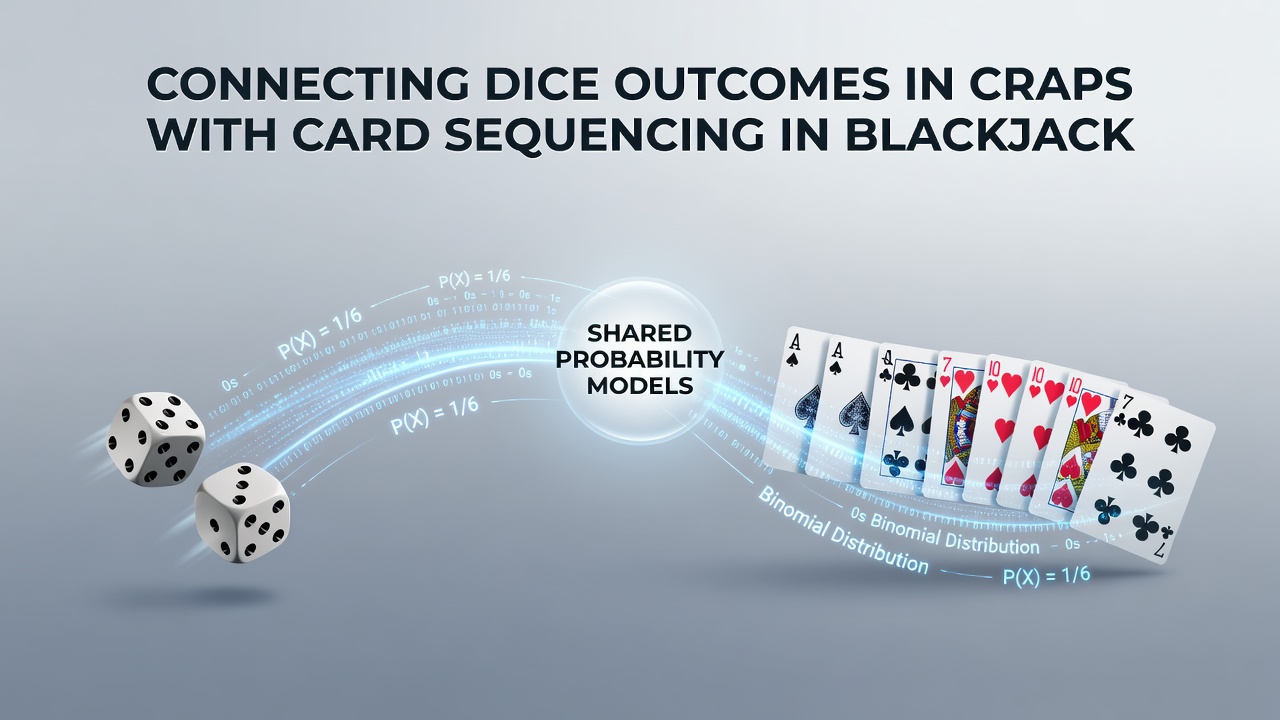
Probability models provide the foundation for analyzing outcomes in both craps and blackjack, where dice rolls and card draws follow distinct yet mathematically linked patterns that researchers apply across casino games. Craps relies on repeated independent trials with two six-sided dice, while blackjack involves dependent events shaped by the finite composition of a shoe or deck, yet analysts connect these through shared frameworks such as distribution theory adn simulation techniques that quantify expected values and variance over many plays.
Dice Outcome Patterns in Craps
Each roll in craps produces one of 36 equally likely combinations, and the game structures bets around point establishment and resolution phases that unfold across multiple independent rolls until a seven appears or the point repeats. Observers note that the probability of rolling a seven equals 6/36 or approximately 16.67 percent on any given throw, which drives the house edge calculations for pass line and come bets that sit near 1.41 percent according to standard combinatorial analysis. Researchers apply binomial distributions to sequences of rolls when evaluating multi-roll bets like place numbers or hardways, and these same statistical tools extend naturally to other table games where repeated trials accumulate.
Card Sequencing Dynamics in Blackjack
Blackjack card sequencing depends on the removal of specific ranks from a finite deck, which creates conditional probabilities that shift as play progresses through a shoe. Basic strategy charts derive from exhaustive enumeration of all possible player and dealer hands, yet card counting systems track remaining high and low cards to adjust bet sizes when the remaining composition favors the player. Data from regulatory testing shows that a single deck game without reshuffling yields a player edge that can exceed 1 percent under optimal counting conditions, whereas multi-deck shoes dilute this advantage unless deeper penetration occurs. Analysts model these shifts using hypergeometric distributions that account for the exact number of cards drawn without replacement, a method that parallels the combinatorial counting used in dice outcome studies.
Shared Frameworks Across Both Games
Markov chains offer one bridge between the two games because craps transitions between states such as point-on and point-off while blackjack moves through deck composition states that depend on prior draws. Monte Carlo simulations replicate millions of craps rolls and blackjack hands to estimate long-run returns and volatility measures that casinos use for risk assessment. In August 2026 the International Gaming Institute released updated simulation datasets comparing variance profiles across table games, revealing that both craps and blackjack exhibit similar standard deviation patterns when normalized by average bet size. These models help operators set table limits and reserve requirements, and they draw on the same underlying random number generation techniques validated by testing laboratories in multiple jurisdictions.

Generating functions provide another common mathematical language, allowing researchers to express the probability generating function for a single craps roll and then raise it to the power of expected roll counts for multi-roll bets. The same approach adapts to blackjack when analysts compute the exact probabilities of dealer busts or player totals by expanding polynomials that represent remaining card ranks. Evidence from academic papers shows that these techniques reduce computational complexity and enable faster evaluation of rule variations such as double after split or surrender options. Those who study gaming mathematics observe that the law of large numbers applies uniformly, smoothing short-term fluctuations in both dice and card outcomes toward their theoretical expectations after thousands of decisions.
Applications in Operational Analysis
Casino surveillance and compliance teams employ these shared models to detect deviations from expected play patterns, whether that involves prolonged hot streaks at craps tables or unusual bet progression in blackjack pits. Regulatory bodies such as the Nevada Gaming Control Board require probability reports that incorporate both independent and dependent trial structures before approving new table layouts or side bets. A 2024 study from the University of Nevada, Las Vegas examined cross-game correlations in player behavior and found that individuals who favor craps often apply similar bankroll management logic when switching to blackjack, even though the underlying dependence structures differ. Software tools used by gaming laboratories now integrate unified simulation engines that handle dice, cards, and even roulette wheels within a single probability framework.
Conclusion
Shared probability models continue to link dice outcomes in craps with card sequencing in blackjack through established statistical methods that quantify risk and return across both games. As simulation capabilities expand and regulatory standards evolve, analysts rely on these overlapping frameworks to maintain consistent evaluation standards for table game performance and player advantage calculations.